DooDooLamb News
The AI Domino Effect: How Artificial Intelligence is Beginning to Erase Entire Job Sectors
Brief published February 25, 2026 · Original source published February 24, 2026
Original reporting by Mike Adams at naturalnews.com.
Automated brief. Verify important details at the original source.
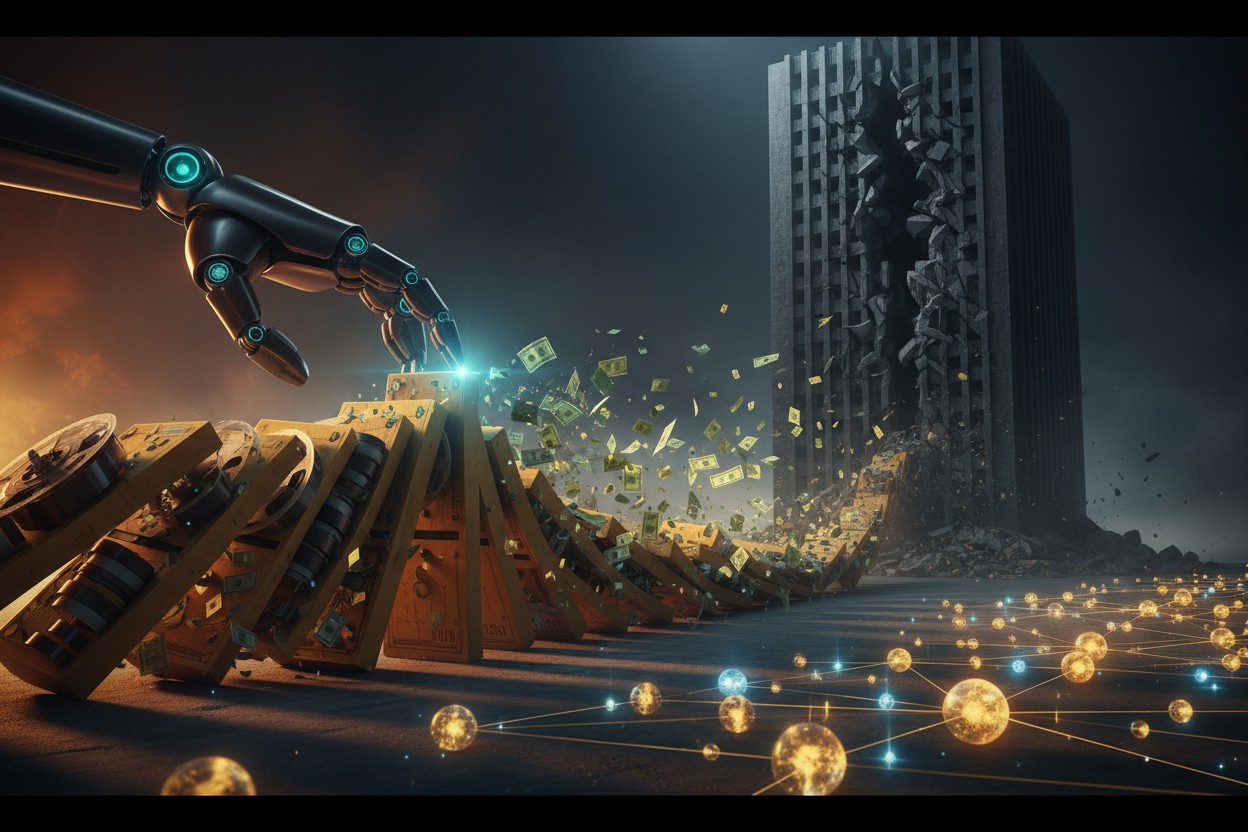
The Day Anthropic Made IBM $30 Billion Poorer
Picture this: you're an IBM executive enjoying your morning coffee when suddenly your phone explodes with notifications. In the span of a single afternoon, your company just lost $30 billion in market value. The culprit? Not a scandal, not a failed product launch, but an announcement from a relatively young AI company called Anthropic about their latest model.
Welcome to the new reality of artificial intelligence, where a single breakthrough can trigger financial tsunamis that reshape entire industries overnight. This isn't just another tech story about impressive benchmarks or flashy demos. This is about AI crossing the Rubicon from "helpful assistant" to "industry disruptor," and the market is starting to panic about what comes next.
The tremor began when Anthropic unveiled capabilities in their AI model that directly threatened traditional enterprise software and consulting services, IBM's bread and butter. While the specific technical details of Anthropic's announcement remain the subject of intense speculation, the market's reaction was swift and brutal. Investors didn't wait for quarterly reports or analyst deep dives. They simply looked at the writing on the wall and decided that IBM's traditional business model might be living on borrowed time. The $30 billion market cap evaporation wasn't just a number on a screen; it represented a collective "oh shit" moment as investors realized that AI isn't just coming for blue-collar jobs anymore.
This market upheaval reflects a broader pattern emerging across multiple sectors. AI systems are no longer confined to simple automation tasks or generating cute chatbot responses. They're beginning to perform complex cognitive work that was previously the exclusive domain of highly educated professionals. Take code generation, for instance, where AI can now write, debug, and optimize software with increasing sophistication. Or consider data analysis and business intelligence, where AI models can process vast datasets and generate insights faster than teams of analysts. Even creative industries aren't immune, with AI systems producing marketing copy, design elements, and strategic recommendations that rival human output.
The ripple effects extend far beyond IBM's stock price. When a single AI announcement can wipe out billions in market value from an established tech giant, it signals that we've entered uncharted territory. Traditional companies built on human expertise and consulting services are suddenly finding themselves in the position of horse-and-buggy manufacturers watching the first Model T roll off the assembly line. The difference is that this transition is happening not over decades, but over months and quarters.
What makes this particularly unsettling for established players is the speed and scope of AI's advancement. Unlike previous technological disruptions that typically affected one industry at a time, AI has the potential to simultaneously impact multiple sectors. Financial services, healthcare, legal services, education, and enterprise software are all facing the same existential question: if an AI can do the work faster, cheaper, and potentially better, what's the long-term value proposition for human-centered businesses?
The IBM market reaction serves as a canary in the coal mine for other established tech companies and service providers. It's a stark reminder that in the age of artificial intelligence, disruption doesn't announce itself with a polite knock on the door. It kicks the door down, moves in, and starts rearranging the furniture while you're still processing what just happened. The companies that survive this transition will be those that can adapt quickly, not those that hope the storm will pass.
As we watch this AI-driven reshuffling of the economic landscape, one thing becomes crystal clear: the question isn't whether artificial intelligence will transform entire job sectors, but how quickly it will happen and which companies will be left standing when the dust settles.