DooDooLamb News
AI-based precision prognostics and therapy personalization for childhood brain tumors
Brief published November 4, 2026 · Original source published November 3, 2026
Original reporting by Sabina Stefan, Amelie S. Amann, Kyle S. Smith at nature.com.
Automated brief. Verify important details at the original source.
What happened
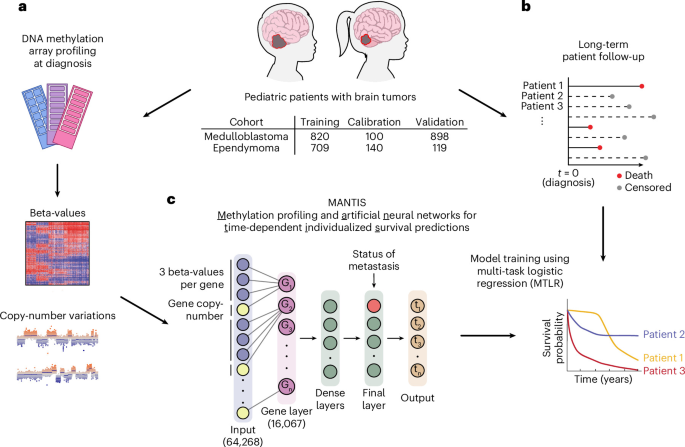
Stefan et al. developed MANTIS, an AI model designed to predict individualized survival outcomes in childhood brain tumors using routine DNA methylation profiling. The study drew on previously collected, de-identified patient cohorts and public datasets rather than prospective recruitment. The model is framed as a tool for therapy personalization, with the claimed potential to flag patients who may respond adequately to less intensive treatment regimens, thereby reducing lifelong side effects associated with aggressive pediatric cancer therapy.
Why it matters
Pediatric brain tumor treatment carries long-term toxicity risks, and matching treatment intensity to individual prognosis is an active clinical challenge. A model that operates on routine methylation data, rather than requiring novel or expensive assays, could lower the barrier to adoption if external validation confirms the findings.
What to watch
The study relies on retrospective, de-identified data, so prospective validation across independent clinical sites is the critical next step. Builders and clinicians should watch for follow-up studies that test MANTIS on new patient cohorts and assess real-world integration into treatment planning workflows.