DooDooLamb News
Conversational brain AI for adaptive epilepsy care
Brief published October 17, 2026 · Original source published October 16, 2026
Original reporting by Samden Lhatoo, Vladimir Vashin at nature.com.
Automated brief. Verify important details at the original source.
What happened
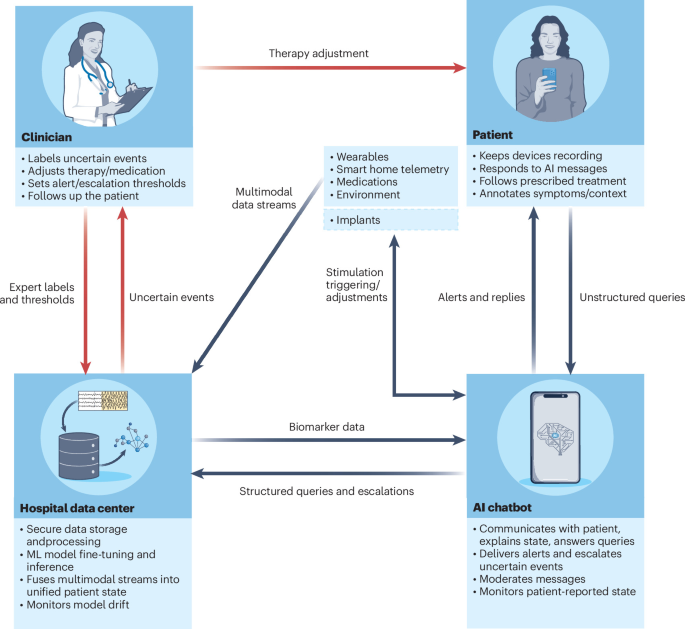
A small study found that patients can help calibrate their own seizure detection systems by conversing with an AI agent. The approach allows individuals to provide feedback that fine-tunes the detector's behavior, shifting some of the adjustment work from clinicians to patients themselves. The evidence base is limited in scale, and the study appears in a research context citing prior neurology and human-factors literature.
Why it matters
Personalized seizure detection is a known challenge because epilepsy presentations vary widely across patients. If conversational AI can incorporate patient-reported feedback to improve detector accuracy, it could reduce the burden on specialist clinicians and make adaptive neurotechnology more accessible. The finding suggests a path toward systems that update continuously based on lived patient experience rather than periodic clinical review.
What to watch
Researchers identify building AI that responds appropriately to patient input as the harder unsolved problem. Whether conversational agents can handle ambiguous, inconsistent, or medically significant feedback without introducing errors remains an open question that future, larger studies will need to address.