DooDooLamb News
Spatiotemporal AI-based modeling of gene regulation and variant effects in the developing human brain using Seal
Brief published October 16, 2026 · Original source published October 15, 2026
Original reporting by Yun Hao, Christopher Y. Park, Chandra L. Theesfeld at nature.com.
Automated brief. Verify important details at the original source.
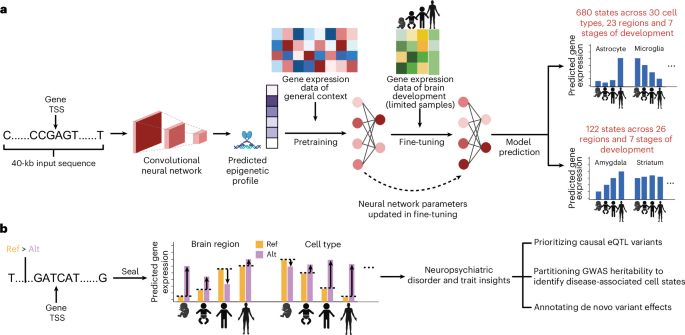
What happened
Researchers introduced Seal, an AI framework designed to predict how regulatory genetic variants affect gene expression across 802 distinct brain cell states. The system models spatiotemporal gene regulation, meaning it accounts for both the location and developmental timing of regulatory activity in the human brain. By doing so, Seal claims to identify which specific cell types and developmental windows are linked to neuropsychiatric conditions, moving beyond standard genome-wide association studies that flag associations without clarifying biological mechanisms.
Why it matters
Translating genetic associations into functional understanding has long been a bottleneck in neuropsychiatric research. Seal's cell-state-level resolution could help researchers prioritize which variants and cell populations to investigate experimentally, potentially accelerating target identification for conditions such as schizophrenia or autism where genetic architecture is complex and poorly understood.
What to watch
Whether Seal's variant-effect predictions hold up under experimental validation will determine its practical utility. Independent replication across additional brain datasets and cell atlases will be a key next step to assess generalizability.