DooDooLamb News
Ensuring multiomics data reproducibility for artificial intelligence with reference materials as a common calibrator
Brief published September 2, 2026 · Original source published September 1, 2026
Original reporting by Leming Shi, Wenjun Bao, Aedín C. Culhane at nature.com.
Automated brief. Verify important details at the original source.
What happened
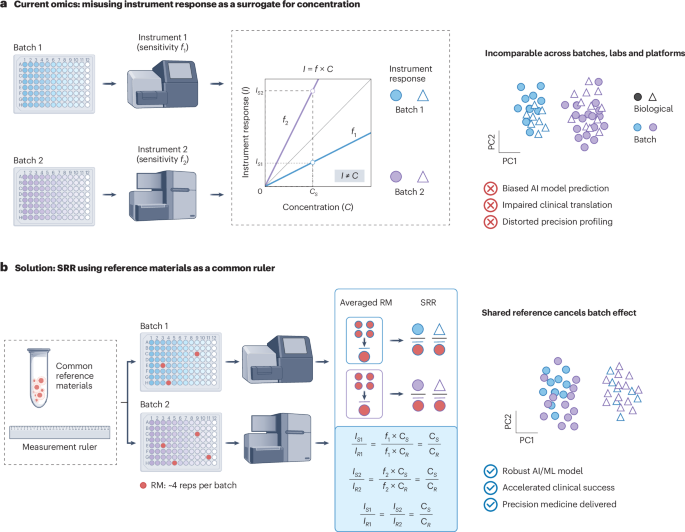
A study published in Nature proposes that reference materials should be adopted as a common calibrator across multiomics measurements. The core recommendation is that reference materials be co-profiled alongside study samples and that results be reported as sample-to-reference ratios rather than raw values. The authors argue this approach makes multiomics data reproducible across labs and platforms, which is a prerequisite for training and validating AI models on biological data. The evidence draws on cited work spanning genomics, clinical oncology, and AI-readiness of biological datasets.
Why it matters
AI models trained on multiomics data are only as reliable as the data itself. Batch effects and platform inconsistencies are known failure points when combining datasets from different sources. If the ratio-based calibration approach gains adoption, it could reduce a major source of noise that currently limits how well AI generalizes across multiomics studies, particularly in clinical oncology applications.
What to watch
Whether standards bodies or large multiomics consortia move to mandate reference material co-profiling, and whether AI benchmarks for biological data begin requiring ratio-normalized inputs as a condition of reproducibility claims.