DooDooLamb News
Are Those Fake Books on the New Air Force One AI-Generated?
Brief published July 5, 2026 · Original source published July 3, 2026
Original reporting by Matt Novak at gizmodo.com.
Automated brief. Verify important details at the original source.
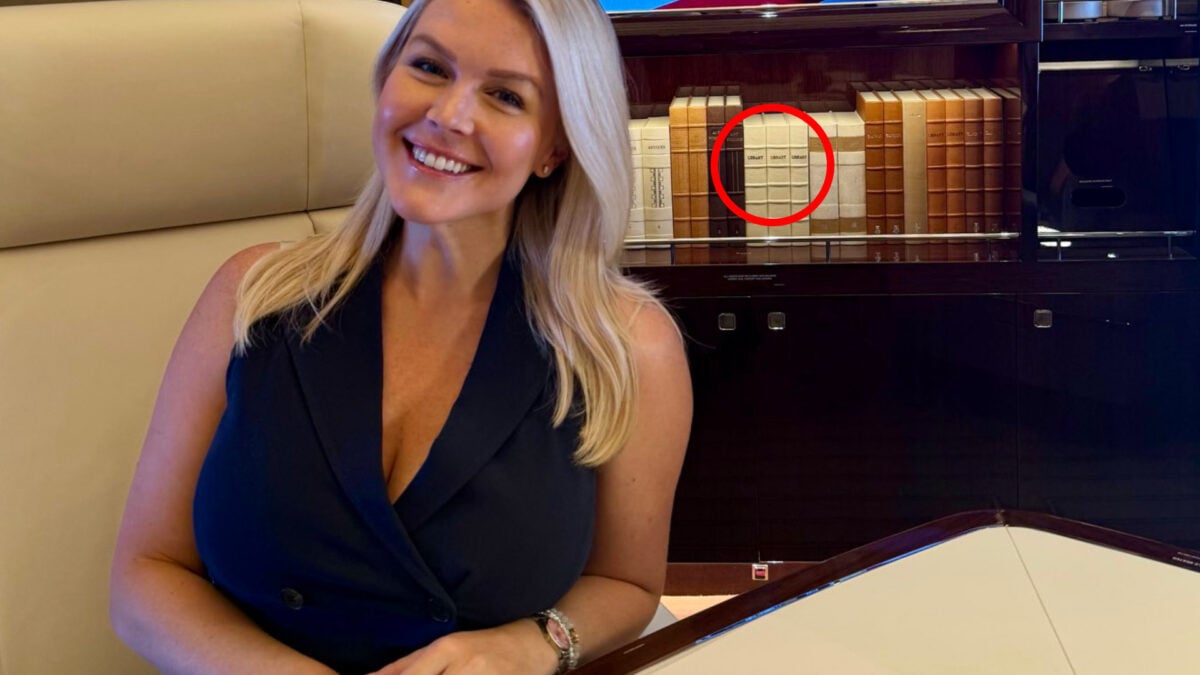
The White House Decorated Air Force One With Books, Which Is Already Suspicious
The United States government accepted a luxury jet from Qatar, and the first thing anyone noticed was that the bookshelves looked fake. This is the timeline we're living in.
White House Press Secretary Karoline Leavitt posted a photo to X this week showing off the interior of the new Air Force One, a Boeing 747 gifted to the Trump administration by the government of Qatar. The plane is, by all accounts, genuinely lavish. And yet, the detail that broke the internet's collective brain was not the geopolitical implications of a sitting president accepting a $400 million aircraft from a foreign government despite laws that exist specifically to prevent this kind of thing. No, the detail that broke the internet was the bookshelf.
The books on that bookshelf, you see, look like they were generated by an AI that had only ever heard books described secondhand by someone who had never read one.
The Books Are, Technically, Real
Here is where it gets philosophically interesting, or at least as philosophically interesting as a story about fake-looking books on a bribery-adjacent airplane can get. The books are not, strictly speaking, AI-generated. They are real physical objects that exist in three-dimensional space and presumably have pages. What they appear to be is a decorative prop product, the kind of thing you can order in bulk from an interior design supplier, where books are printed with generic, unreadable spines and stacked on shelves to signal "a person of culture lives or works here" without requiring anyone involved to have ever experienced culture firsthand.
In other words, they are the physical-world equivalent of a stock photo of a bookshelf. They are books the same way a painted fireplace is a fireplace. They fulfill the aesthetic contract of books while opting out of the content contract entirely. If you tried to read one, you would be briefly confused and then deeply unsettled.
The reason everyone immediately assumed they were AI-generated is instructive. We have now collectively trained ourselves to recognize a specific visual texture of wrongness: spines with letters that almost form words, titles that gesture at meaning without committing to it, the uncanny valley of signifiers divorced from signified. The fake prop books and the AI-generated books have converged on the same aesthetic, which says something interesting about both AI image generation and the interior design choices of people who want to look smart without the overhead of actually being smart.
The Plane Itself Is a Whole Other Conversation
The backdrop to this bookshelf discourse is that the United States accepted a luxury 747 from Qatar, a country with an active U.S. military base on its soil and a long and complicated diplomatic relationship with Washington. The Foreign Emoluments Clause of the Constitution exists specifically to prevent foreign governments from giving things of value to U.S. officials, on the theory that gifts from foreign powers have a tendency to come with invisible strings that don't show up on the customs declaration. Legal scholars have described the arrangement as anywhere from "legally dubious" to "a stress test for institutions that were not designed to be stress-tested this aggressively."
The administration's position is that the plane is being gifted to the Department of Defense, not to Trump personally, which is a distinction that is technically a distinction. It is the governmental equivalent of saying your friend didn't give you a car; they gave the driveway a car. The driveway happens to be yours.
But none of that is why we're all staring at the bookshelf.
The Reality Check
What this story actually illustrates, beyond the obvious jokes, is a genuine and slightly vertiginous shift in how we process visual information. The AI suspicion was wrong in this specific case, but the instinct behind it was not unreasonable. AI-generated images of books produce exactly this kind of plausible-but-off visual static, and we've seen enough of them that the pattern-matching is now automatic. The problem is that the same wrongness can be produced by humans who are simply not trying very hard, which means we now live in a world where "this looks AI-generated" and "this looks like nobody cared" are increasingly pointing at the same thing.
For developers and people building products with generative AI: this is your warning label. When your outputs are visually indistinguishable from prop furniture purchased in bulk from an Alibaba storefront, you have not built something impressive. You have built something that looks like the books on Air Force One.
The Closing Thought
A foreign government gave the United States a $400 million airplane, and the national conversation settled on whether the decorative books look real. The books are real. The legal and ethical framework for evaluating the plane is also real, technically, though it appears to be functioning about as well as a painted bookshelf holds actual knowledge. At least we can all agree the aesthetic is consistent.