DooDooLamb News
The NTSB tries to keep cockpit audio recordings private. AI is making that harder
Brief published June 1, 2026 · Original source published May 30, 2026
Original reporting by Joel Rose at npr.org.
Automated brief. Verify important details at the original source.
NTSB Discovers That Privacy Dies Hard When Your Audio Gets the AI Treatment
The National Transportation Safety Board just learned what every teenager with a Ring doorbell already knows: once audio exists in digital form, someone with too much time and the right software will figure out how to extract every embarrassing detail from it. This week, the federal agency that investigates plane crashes had to yank its entire public records system offline after discovering that AI tools could reconstruct supposedly private cockpit conversations from visual spectrograms.
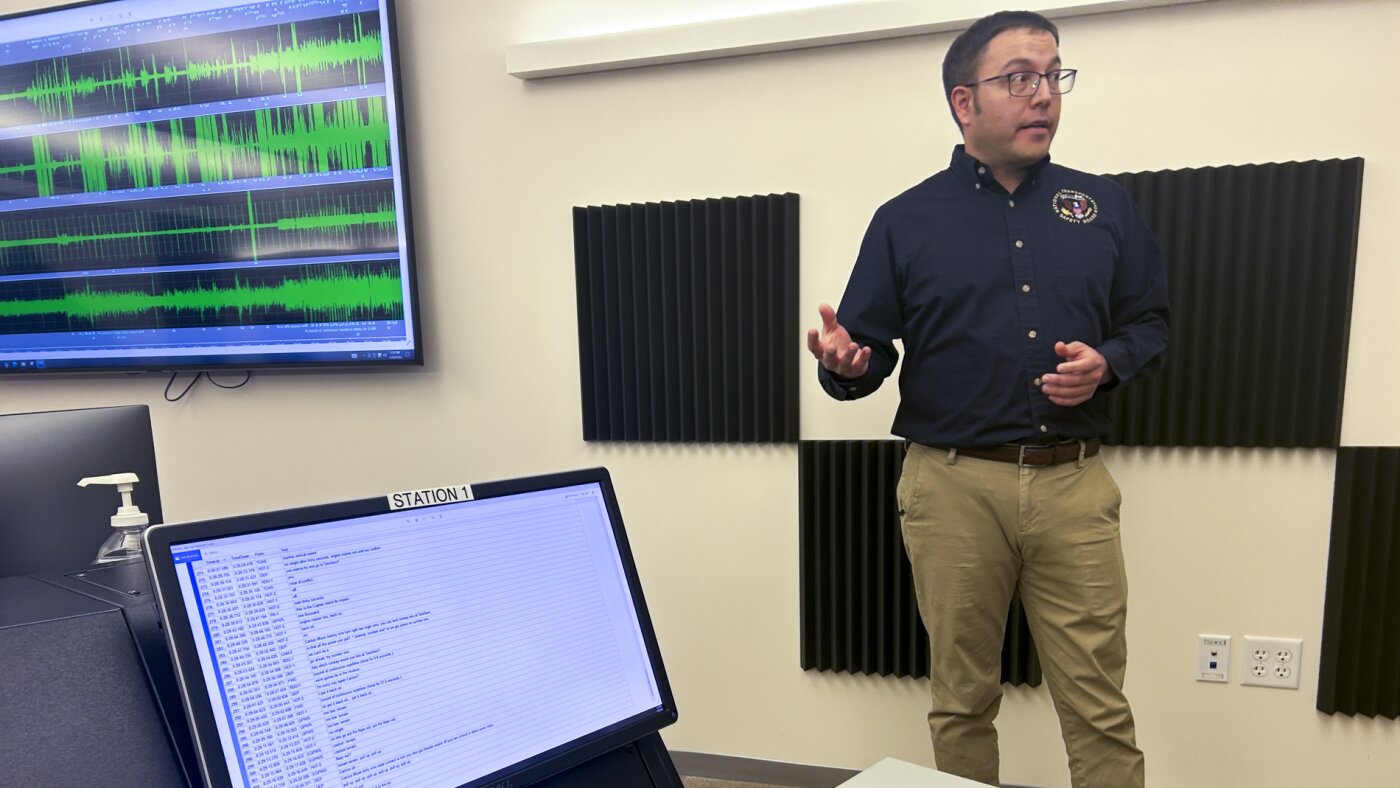
The trouble started when some digital detectives decided to play CSI with publicly available crash investigation materials. The NTSB, in its commitment to transparency, routinely publishes visual representations of cockpit voice recordings called spectrograms. Think of them as the audio equivalent of a heart monitor readout: squiggly lines that show sound waves over time. For decades, these charts served as a perfect compromise between public accountability and pilot privacy. Investigators could reference specific moments in conversations without broadcasting the actual words of people having the worst day of their professional lives.
But then artificial intelligence had to go and ruin everything, as it tends to do. Researchers and hobbyists discovered they could feed these visual spectrograms into machine learning models trained on speech recognition, effectively turning the squiggly lines back into actual audio. It's like someone figured out how to reconstruct a phone conversation from looking at the patterns on an oscilloscope, except the someone is a neural network that never sleeps and has read every aviation manual ever written.
The implications hit the NTSB like a bird strike at 30,000 feet. Suddenly, their careful balance between transparency and privacy looked about as secure as airplane WiFi. The cockpit voice recorder, known in the industry as the CVR, captures the final 30 minutes to two hours of conversation in the cockpit (depending on the aircraft). This isn't just official pilot-to-air-traffic-control chatter. It's everything: casual conversation, personal phone calls during cruise, discussions about company policies, and yes, sometimes the raw human reactions of people realizing their day is about to get much worse.
The legal framework around CVR recordings reads like it was written by people who never imagined you could reverse-engineer audio from a picture of sound waves. Federal law strictly prohibits the public release of actual cockpit voice recordings, with exceptions only for official safety investigations and court proceedings. The reasoning is sound: pilots need to communicate freely without worrying that their every word will end up as content for aviation YouTube channels. But lawmakers in the 1990s couldn't have predicted that showing someone a graph of audio would eventually become equivalent to playing them the audio itself.
This isn't the first time AI has turned "anonymized" data back into personally identifiable information. The same technology that can generate deepfakes and clone voices from a few seconds of audio has been steadily chipping away at traditional privacy protections. Researchers have demonstrated similar techniques with everything from medical imaging to financial transaction patterns. The NTSB just happened to be the latest organization to discover that their privacy-by-obscurity approach had an expiration date, and AI decided to move that date up by about a decade.
The aviation industry is watching this unfold with the kind of nervous attention usually reserved for unusual engine noises. Pilots' unions have long fought to keep CVR recordings private, arguing that open cockpits lead to safer flights. The fear is that if pilots know their conversations might become public, they'll self-censor crucial safety communications. Nobody wants to be the pilot who didn't mention a weird vibration because they were worried about sounding stupid on what might become a viral audio clip.
Meanwhile, families of crash victims and safety advocates have pushed for greater transparency, arguing that public access to investigation materials leads to better oversight and accountability. The spectrograms were supposed to thread this needle perfectly: detailed enough for technical analysis, obscure enough to protect privacy. That compromise just got obliterated by the same technology that can write your performance review and generate pictures of cats wearing tiny business suits.
So here we are, in the familiar position of watching regulators play catch-up with technology that moves faster than a congressional hearing. The NTSB has temporarily removed public access to its investigation files while they figure out how to release safety information without accidentally releasing everything else. It's a regulatory nightmare wrapped in a technical puzzle, served with a side of "nobody saw this coming" (even though plenty of people probably should have).
The real story here isn't that AI can turn pictures back into sound. The real story is that our entire framework for balancing transparency and privacy was built on the assumption that some things would always be technically impossible. That assumption just joined the ranks of "the internet is just a fad" and "nobody will ever need more than 640K of RAM." The NTSB will figure out new ways to share safety data while protecting pilot privacy, but they'll do it knowing that whatever technical barriers they put up today might be yesteryear's obstacles tomorrow. Welcome to the age where your privacy policy needs its own software update schedule.