DooDooLamb News
Ask.com Is Dead, and I’m Begging Its Owners Not to Bring AskJeeves Back as a Chatbot
Brief published May 5, 2026 · Original source published May 3, 2026
Original reporting by Mike Pearl at gizmodo.com.
Automated brief. Verify important details at the original source.
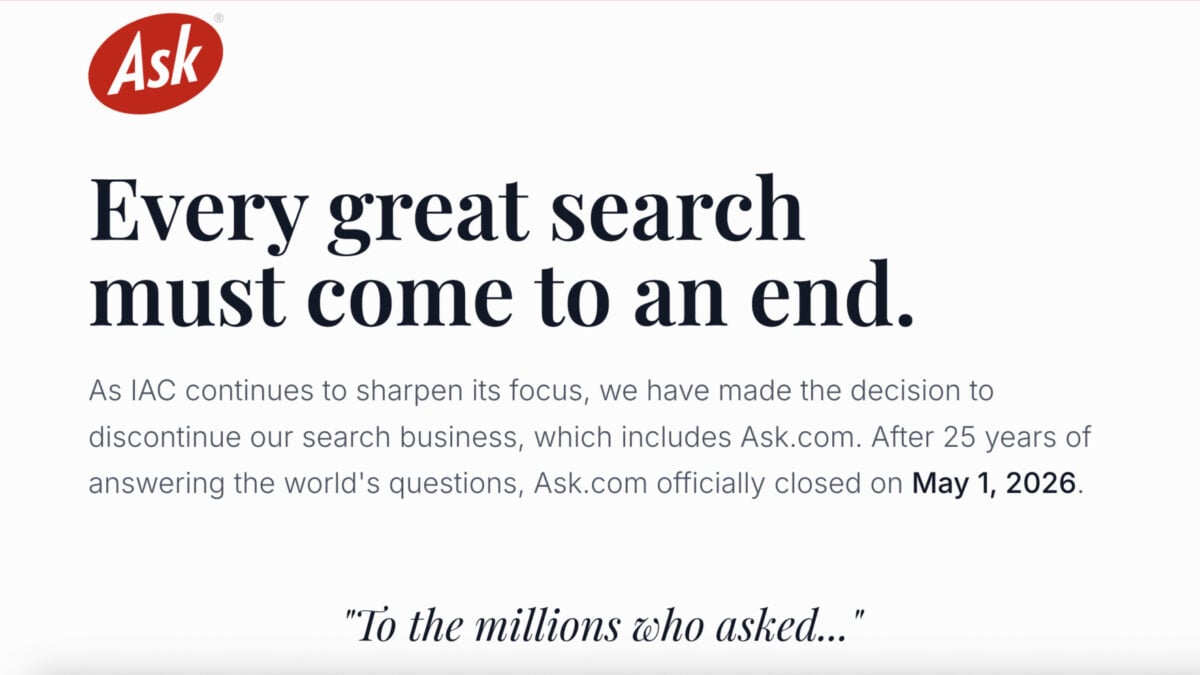
Ask.com Finally Dies, Immediately Inspiring the Worst AI Pivot Ideas Since Microsoft Clippy Met ChatGPT
Ask.com has officially shuffled off this mortal coil, and somewhere in a venture capital office, three different partners are already scheduling calls about "bringing back that butler guy with modern AI." Please, for the love of all that is holy in tech, let Jeeves stay dead.
The search engine that nobody really used but everyone vaguely remembers finally pulled the plug this week, redirecting users to a generic landing page that essentially says "we tried." Ask.com spent the last two decades in that special internet purgatory reserved for brands like Friendster and Yahoo Answers, technically alive but spiritually vacant, kept running by the digital equivalent of life support and whatever ad revenue they could squeeze from people who accidentally typed "ask" instead of "asked" into their address bar.
For those too young to remember the Clinton administration, AskJeeves launched in 1996 with the revolutionary concept that people wanted to ask their search queries in complete sentences to an animated British butler. The idea was that instead of learning Google's mysterious keyword alchemy, you could just type "Where can I find good pizza near me, Jeeves?" and somehow get better results than Alta Vista. This was roughly equivalent to solving the problem of cars being too fast by inventing a horse with a speedometer.
The service rebranded to Ask.com in 2006, quietly retiring Jeeves like a company mascot who'd been caught embezzling. The butler disappeared, but the fundamental problem remained: Ask was trying to compete with Google by being more polite about delivering worse results. They pivoted through every search trend imaginable—social search, mobile optimization, AI-powered suggestions—like a startup founder cycling through elevator pitches at a Demo Day after-party. Nothing stuck, because when your core value proposition is "Google, but British," you're not solving a problem that exists.
The real tragedy here isn't that Ask.com is dead. It's that someone, somewhere, is absolutely convinced this is the perfect moment to resurrect Jeeves as an AI chatbot. You can practically hear the pitch deck being assembled: "Imagine ChatGPT, but with the trusted brand recognition of that butler everyone remembers from the dial-up era." They're probably already workshopping names like "AI Jeeves" or "JeevesGPT" or, God help us all, "Butler.ai." The venture capital presentation will feature a slide about "nostalgic brand activation in the conversational AI space" that makes everyone in the room slightly nauseous.
This is exactly the kind of thinking that gave us New Coke, Google+, and the Zune. Some executive will convince themselves that the problem with Ask.com wasn't that it was fundamentally unnecessary, but that it was simply ahead of its time. "Users weren't ready for conversational search in 2006," they'll say, gesturing at a graph that shows ChatGPT's user adoption curve, "but now they are." They'll conveniently ignore that modern AI assistants work because they're powered by language models trained on the entire internet, not because users were secretly yearning to ask their questions more formally.
The most infuriating part is that they're probably right about the market timing, just wrong about the execution. Conversational AI is genuinely useful when it's built on solid foundations and designed for actual human needs. But slapping a British accent on Claude and calling it "Jeeves 2.0" isn't innovation—it's necromancy with venture funding. It's the digital equivalent of digging up a failed restaurant chain and reopening it as a ghost kitchen, complete with the same menu that nobody wanted the first time around.
What Ask.com's death actually represents is the final closing of the pre-Google search era, when companies could build entire businesses around being slightly different flavors of "not quite Yahoo." Those days are gone, buried under two decades of algorithmic improvements and user behavior changes that have made search a solved problem for everyone except the people still trying to reinvent it. The internet moved on, users moved on, and Ask.com became a digital fossil preserved in amber made of expired domain registrations and abandoned marketing budgets.
The reality is that most developers and founders reading this have already forgotten Ask.com existed until this very moment. If you're building something in the AI space, you're not competing with the ghost of AskJeeves—you're competing with OpenAI, Anthropic, and Google's actual AI products that people actually use. Resurrecting dead brands with ChatGPT integrations is the business strategy equivalent of trying to make fetch happen. It's not going to happen.
Let AskJeeves rest in peace in that great server farm in the sky, alongside Geocities pages and Internet Explorer 6. Some things are better left buried, and no amount of artificial intelligence can resurrect a brand whose only distinguishing feature was being polite about delivering search results that were already obsolete when the iPhone was still just a rumor.